
Special Educational Needs (SEND)
Special Educational Needs and Disabilities (SEND) Information Report
We pride ourselves on being an inclusive school. Our provision is 'needs-led', meaning we give each child what they need to be able to enjoy their time at school, and to make good progress.
We understand that all children learn differently. We know that some of our children are neuro-diverse and so have established an ethos across the school where all of our children know that our strengths are in our differences, not in our similarities.
We believe in equity in education. Giving each child what they need (equity), rather than treating all children the same (equality).

'Staff identify the needs of pupils with SEND accurately. This information is used effectively to help pupils with SEND access the same curriculum as their peers. Teachers adapt lessons appropriately.'
'The school has developed ‘the nest’ as a separate provision for a small number of pupils with specific needs. Staff in the nest are highly trained. They provide a bespoke curriculum which enables pupils who attend to thrive.'
Ofsted, 2025
On this page you will be able to read our policies relating to SEND and inclusion; find out about our support offer, and find helpful resources and information.
If you have a child with additional needs, we welcome you to arrange a visit to our school, or feel free to contact our SENCO via the admin email: admin@hollybush.herts.sch.uk
At Hollybush Primary School, we are committed to being an inclusive school through our "Graduated Offer" where the foundation of our support is Universal, Ordinarily Available Provision. This is the provision we expect to be made available for all children from within our own resources. Most children’s needs will be met through this provision. However, some children may need something more.
All Hertfordshire maintained schools have a similar approach to meeting the needs of pupils with Special Educational Needs and/or Disabilities (SEND). We are supported by the Local Authority to ensure that all pupils, regardless of their specific needs, make the best possible progress in school. Schools aim to be inclusive, with the needs of SEND pupils being met in a mainstream setting wherever possible, if families wish this to happen.
Should you have any questions, please speak to the SENCO (Dunni Smail), Deputy Headteacher (Hannah Cracknell) or Headteacher (Jeremy Fisher) for further advice.
Please use the following questions and answers below to understand how children with SEND can be supported at Hollybush Primary School.
Click on each heading for the answers to each question.
Aims
Universal Provision:
As many children as possible will have their needs met through high quality, ordinarily available provision.
Adaptive Teaching:
We have moved beyond traditional "differentiation" to adaptive teaching, ensuring teachers evaluate and use distinctive approaches to engage all learners.
Anticipatory Duty:
We fulfil our statutory duty to think ahead about what disabled pupils might need, treating them more favourably than non-disabled peers where necessary to ensure equity.
How does the school know if children need extra help and what should I do if I think my child may have SEND?
According to the SEND Code of Practice: 0-25 years, ‘A pupil has SEND where their learning difficulty or disability calls for special educational provision, namely provision different from or additional to that normally available to pupils of the same age’.
At Hollybush, we identify needs through the Hertfordshire Graduated Offer.
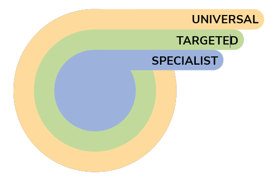 ‘In Hertfordshire we have levels of support for children and young people in education, according to their needs. The levels start with universal, ordinarily available provision and move through a range of other targeted and specialist provisions. We call this the ‘graduated offer’ - an approach which is all about making sure that children and young people, including those with SEND get the right support at the right time.’
Hertfordshire Ordinarily Available Provision, September 2025
At Hollybush, most children's needs are met through Ordinarily Available Provision—the adaptations and reasonable adjustments that are an integral part of our everyday high-quality teaching. Our teachers are experienced, and offer all children a structured, safe and inclusive environment to learn. Our curriculum is planned in a way to ensure all children can access learning opportunities. If pupils can answer the KLQ (Key Learning Question), then they have met the objective of the lesson. Our teachers use a variety of scaffolds and resources to help all children answer the questions at their level.
Teachers continuously assess children through regular pupil progress and attainment meetings. When progress and attainment are significantly below age related expectations further assessment may be necessary. If you think your child may have SEND you should arrange to meet the class teacher to discuss your concerns. This may be at a parent's evening, by telephone, e-mail or by appointment. Sometimes it might be necessary for the school’s Special Educational Needs Coordinator (SENCO) and outside professionals to be involved.
Key Staff Members
Please email admin@holybush.herts.sch.uk and your email will be forwarded on to the appropriate person. We aim to respond within three working days.
SENCo: Dunni Smail (Interim SENCo covering maternity leave from March 2026)
Governor for SEND: Graham Nickson
Mental Health Lead & Mental Health First aider: Jeremy Fisher and Charley Tilbury
How will the school staff support my child?
Our support is ‘needs-led’. Most children will be supported at the ‘universal’ level.
Universal Tier: Teachers use adaptive teaching (e.g., scaffolds, visual supports, and quiet spaces) as part of our ordinarily available offer.
Targeted Tier: For pupils requiring support "additional to or different from" the universal offer, we use 'Stepping Stones' targets reviewed termly.
Specialist Tier: We collaborate with partners such as Educational Psychologists, Speech & Language Therapists, and Outreach teachers.
The class teacher is responsible for all the children in their class, including those with SEND. Learning is carefully planned and adapted to cater for children with differing abilities. We have high aspirations of all our children and aim to teach all children at ARE (age-related expectations). If your child requires extra support, they may receive support through carefully matched resources within the class setting. It may be necessary for your child to receive extra support in small groups or occasionally on a one-to-one basis to help support any gaps in their learning. These small intervention groups can be run by the class teacher or by a teaching assistant. The Special Educational Needs Coordinator may suggest the involvement of an outside specialist. Children who need highly individualised provision will have learning targets set for them through ‘Stepping Stones’. These targets will be set and reviewed termly with parents, teachers and, where appropriate, the child and progress will be carefully tracked. Parents will be fully involved at every stage of the process.
How will I know how my child is doing?
- Parents’ evenings are held in the Autumn and Spring terms.
- Class teachers write an annual report at the end of the Summer term.
- Parents may request a meeting with the class teacher by phone or at the school office. Meetings can also include the SENCO.
- Children with SEND may also have meetings with external professionals or agencies.
- Stepping Stones targets are reviewed termly with parents.
How will the learning and development provision be matched to my child’s needs?
Universal, ordinarily available provision from the class teacher is vital. It is carefully planned and adapted to meet your child’s needs and those of all the children. Children will often have suitable resources to support them in achieving age-related objectives. Small group learning or one-to-one support from teaching assistants will be available where appropriate.
Children with SEND are regularly assessed and meetings between school staff, pupils and parents are held to ensure that the provision meets their needs. Some children may need specific provision matched to their needs through a stepping stones plan or an EHCP.
What support will there be for my child’s overall wellbeing?
Hollybush promotes a relational approach to wellbeing:
- Positive relationships between parents, children, and staff
- No Outsiders teaching within the curriculum and through assemblies teaches all children that ‘no one is the same, but everyone is equal’
- Access to extracurricular activities, e.g., sports and music
- Listening to children’s views via the school council and pupil questionnaires
- PSHE lessons and assemblies addressing wellbeing, bullying, and conflict resolution
- Support from Selections Children’s Centre, School Family Support Worker, and counselling service Safe Space
- Medical support via Medical Health Care Plans
- Emotional support through ELSA (Emotional Literacy Support Assistant) sessions
- School-wide mental health awareness led by Mental Health Lead and deputy, with support from the MHST (Mental Health Support Team)
- Social skills and nurture groups
- Regulation system: Zones of Regulation
- Children with SEND are actively encouraged to apply for School Council and given opportunities to run clubs
What training have the staff, supporting children with SEND had or are having?
All Staff have regular in-school training on a range of SEND needs. This includes ADHD, ASD, SPLD (how to support barriers to learning in the classroom)
The SENCO attends regular external SEND training, SEND briefings and maintains close links with the local SENCO cluster.
Outside agencies and professionals support the school with ongoing advice and recommendations.
We have weekly support from a Speech and Language Therapist to enable our staff to deliver specific programmes to identified children.
Staff have training in Makaton
Staff working with children with specific needs have had bespoke training matched the needs of the child.
What specialist services and expertise are available at or accessed by the school?
Expertise is shared within the school, facilitated by the SENCO. Sometimes the SENCO refers children for advice or support from external professionals after discussions with parents and class teachers.
These services include:
- Educational Psychology (EP) Consultation Appointments
- Speech, Language, Communication & Autism Team
- Outreach Support for specific needs e.g. Autism Family Support Worker
- Primary Behaviour Team
- Speech and Language Services
- Occupational Therapy Service
- School Nurse Team
- Low Incidence Team - Visual Impairment and Hearing Impairment
- SpLD teachers for specific learning difficulties in Maths or English
- Family Support Worker
- Counselling in Schools (Safe Space)
- Step 2 Early Intervention Children and Adolescent Mental Health Service
- Early Years Advisory Team (for nursery children)
Some services are accessed through the General Practitioner (GP). These include:
- Speech and Language services
- Paediatrician
- CAMHS (Children and Adolescent Mental Health Service)
- Nutrition and Dietetic Service
How will you help me to support my child’s learning?
- Information meetings for Nursery and Reception parents
- Curriculum meetings for all year groups at the beginning of the year
- Support and resources sent home via google classroom
- Resources available on the school website
- Parents’ evenings and information evenings on various subjects
- Half-termly SEN coffee mornings for parent networking and training
- Termly meetings to review Stepping Stones targets with the class teacher and SENCO
How will I be involved in discussions about and planning for my child’s education?
Parents attend parent consultations to review targets and discuss progress on a termly basis. For a few children and families with multiple needs a family first assessment (FFA) may be necessary to enable all services involved with the family or child to work together efficiently and share information. Some children will have individual targets set through ‘Stepping Stones’ with parents/carers, teachers, children and possibly the SENCO. A small percentage of children with more complex SEND will have an Education, Health and Care Plan (SEND Code of Practice 2014). This is a statutory document administered by Local Education Authority Special Educational Needs officers ensuring that children receive the provision they need and that their parents’ wishes are taken into account. This is reviewed on an annual basis and both the child’s and family views are gathered before the meeting.
How will my child be included in activities outside the classroom including school trips?
School trips will always be discussed with individual parents where necessary. Risk assessments are always carried out. Whenever necessary, reasonable adjustments will be made to include all children in school trips and activities outside the classroom.
How accessible is the school environment?
All Hertfordshire schools comply with the Equality Act 2010 and make reasonable adjustments to include all children. The Accessibility Plan is updated according to need.
Who can I contact for further information?
In the first instance, always contact your child’s class teacher.
The SENCO and Head Teacher are also available to discuss concerns with parents. Please contact the school office on 01992 581454 or email admin@hollybush.herts.sch.uk to make an appointment.
The school has a SEND Governor. Parents may also contact the Local Authority SEND Officer for further advice.
How will the school prepare and support my child to join the school, transfer to a new school or the next stage of education and life?
Our school works closely with all settings during times of transition. We have meetings and home visits for parents of children entering the school system for the first time and extra visits can be arranged for pupils with SEND. Meetings are also held with preschools and nurseries. We work closely with secondary schools to ensure the smooth transition and transfer of relevant information, including meeting with secondary school staff. Children with SEND are able to have additional visits to their transfer school where needed. Internal transition meetings are held between teachers and support staff for transition between year groups. Where a child is leaving Hollybush to attend another school, records are transferred and discussed within 15 days of the child leaving the school, in compliance with the Education Regulations Act 2000. Both electronic and paper records are transferred and discussed.
How are the school’s resources allocated and matched to children’s special educational needs?
The budget for SEND is decided by the Head teacher and Governing body. Within the budgetary constraints, support is allocated according to the level of need. In exceptional circumstances, an application for Local High Needs Funding can be made to the Local Authority for individual children. Families with EHM support can apply for funding from the personalised commissioning fund.
How is the decision made about how much support my child will receive?
How much additional support a child will receive will be discussed in consultation with the class teacher, parents, SENCO and head teacher. Outside professionals may be involved in these meetings and, where appropriate, your child may be encouraged to attend. Some children with EHCPs may be allocated a number of hours of support. Support for children is ‘needs led’, and we aim to give children what they need to be successful, whether through adaptations in the classroom, reasonable adjustments, interventions or staffing.
SEN Register:
The register details whether a child is:
- Being monitored
- Receiving SEN support
- Has an EHCP
Parents are notified before their child is added to the register.
How can I find information about the Local Authority’s Local Offer of services and provision for children and young people with special educational needs and disability?
Information on the Hertfordshire Local Education Authority offer can be found at:
https://www.hertfordshire.gov.uk/microsites/local-offer/the-hertfordshire-local-offer.aspx